Perkin Karunakaran
Cirrus Aircraft
Perkin “Prat” Karunakaran began his flight test career in 2017 as a Flight Test Engineer at Piper Aircraft, serving as an onboard FTE across a range of avionics, systems, and handling qualities development programs on single and multi-engine platforms. He has extensive experience conducting medium- and high-risk flight tests from both the test aircraft and chase aircraft and served as lead FTE during the development and initial certification of the PA-28 Pilot 100i.
Perkin’s flying journey began through the company flying club at Piper Aircraft and he now holds an ATP certificate, and CFI ratings for both single- and multi-engine airplanes. He has accumulated more than 2,200 hours of flight time.
In 2021, Perkin joined Cirrus Aircraft as an FTE, contributing primarily to the SR10 certification efforts. In 2025, he transitioned to the role of Experimental Flight Test Pilot, supporting a wide range of engineering test activities on the SR10, SR22, and SF50 Vision Jet platforms. He holds a type rating in the SF50 Vision Jet and an Experimental Authorization for the Aero L-39 Albatros.
Perkin also serves as the designated Flight Test Safety Officer for Experimental Flight Test at Cirrus Aircraft. He is an active member of the Society of Flight Test Engineers (SFTE) and the Flight Test Safety Committee (FTSC). He holds a bachelor’s degree in aerospace engineering and a master’s degree in systems engineering, both from Embry-Riddle Aeronautical University.

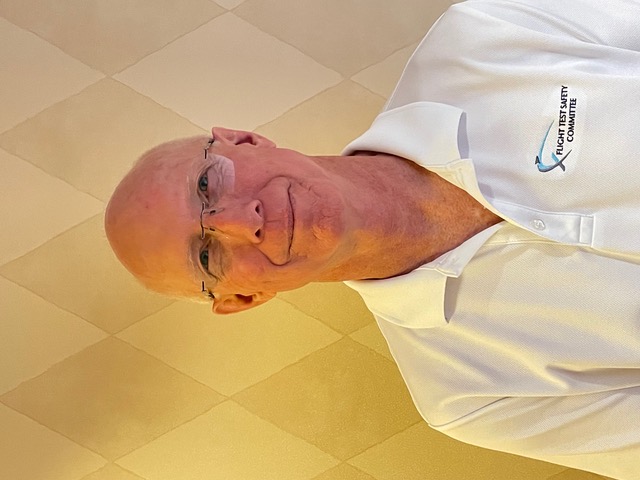 Bruce graduated from the University of Vermont in 1978 (B.S. Civil Engineering) and USNTPS in 1986 (M.S. Aeronautical Engineering). Navy flight test projects included S-3B and T-34C flying qualities, carrier suitability, ordnance and avionics flight tests, including T-34C high angle of attack, stall, and spin testing. Selected as the 1987 Naval Air Test Center Test Pilot of the Year. After S-3B operational tours, Bruce returned to USNTPS in 1991-1992 as the Senior Fixed Wing Flight Instructor/Chief Flight Instructor, and from 1995-1998 as Chief Test Pilot/Commanding Officer of the Force Warfare Aircraft Test Squadron, leading a flight test organization responsible for the execution of over 200 flying qualities, performance, and avionics flight test programs in 22 RDT&E aircraft of 7 type/model/series. After Navy retirement in 1998, Bruce worked at Lockheed Martin as a Test Pilot conducting experimental, developmental, and FAA certification flight tests of the C-130J Hercules II. Bruce presented a paper on C-130J Maximum Crosswind Testing at the 2000 Flight Test Safety Workshop and 2000 SETP Annual Symposium. Bruce continued his flight test career as an Experimental Test Pilot at Raytheon Aircraft Company (Wichita, KS) conducting experimental, developmental and certification flight testing of the Hawker Model 4000 Business Jet. Bruce joined the FAA in 2003 as a Flight Test Pilot in the Atlanta Aircraft Certification Office, and was selected as the Flight Test Branch Manager in 2005, responsible for managing a highly active organization consisting of Flight Test Pilots, Flight Test Engineers, and Human Factors Specialists, conducting certification flight testing of airplanes, helicopters, gliders, and balloons. Bruce became the FAA Flight Test Program Manager (Chief Test Pilot equivalent) in 2017 and stood up the first consolidated, national FAA Flight Test organization responsible for flight test operations, certification, safety, policy, and risk management for all FAA Flight Test personnel. Bruce retired from the FAA in 2021, and now runs Remick Aviation Services LLC, a consulting company specializing in flight testing, flight test operations management and safety risk management services while exercising his appointment as an FAA Flight Test Pilot Designated Engineering Representative (DER). Bruce received the James H. Doolittle Award in 2021